THE ANATOMY OF FORGETFULNESS: WHY DO WE NO LONGER PHILOSOPHIZE?
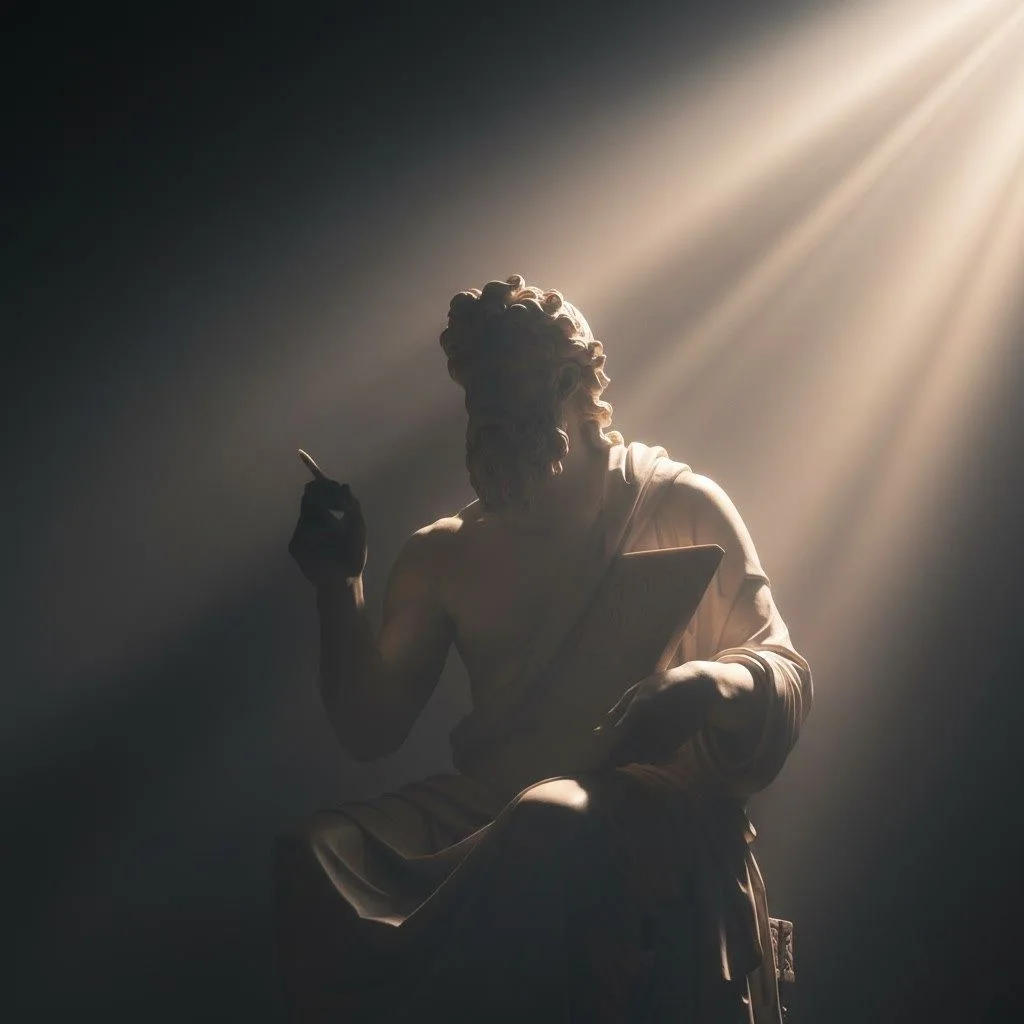
ETUDE Contemporary man lives in the great paradox: he possesses the most sophisticated means of communication, yet he no longer has anything to say that originates from the depth of his being. Philosophy, which was once technē biou – the art of living and the sculpting of the Self – is today a relic exiled to the dusty archives of academia. This “anatomy of forgetting” is not a historical coincidence, but a structural configuration of our age, in which thought has been displaced from the horizon of existential formation into the regime of discursive production. This essay begins from a metaphilosophical thesis: the exile of philosophy is not merely institutional, but ontological. We are not dealing only with its displacement from the agora to the auditorium, but with the transformation of the very meaning of thinking itself. If, as Martin Heidegger warned in Was heißt Denken?, “the most thought-provoking thing in our thought-provoking time is that we are still not thinking,” then the problem does not lie in the lack of information, but in the absence of a profound relationship with Being. Thought has been reduced to data processing; reflection has been replaced by reaction. The exile of thought must be understood as a twofold process: on the one hand, the professionalization of philosophy as a technical discipline; on the other, the colonization of public space by discourses that privilege functionality over meaning. In this context, metaphilosophy emerges as an attempt to restore the fundamental question: what is at stake when we think? Is philosophy the production of theories, or the formation of the subject? This issue is directly connected to the analysis of power and knowledge. Michel Foucault has shown that every regime of truth is connected to practices that produce subjects. In this sense, the exile of philosophy is not merely marginalization, but neutralization: it is allowed to exist for as long as it does not affect the mechanisms of the production of subjectivity. Thus, philosophy risks becoming a commentary on the world, rather than an intervention in it. Metaphilosophy, as a reflection on the conditions and purposes of philosophizing, assumes a critical function here. It does not aim to add another theory to the archive, but to analyze the very structure that turns thought into an object of administration. The question is not only “what is truth?”, but “how is it possible that truth no longer possesses transformative power?” At this point, it must be recalled that, for the classical tradition, philosophy was a way of life. In Pierre Hadot, we find the thesis that ancient philosophy was, above all, a spiritual exercise (exercitium spirituale), not a doctrinal system. Modern exile has reversed this relationship: the system remains, the exercise disappears. The result is a philosophy without existential risk. The aim of this study is to examine precisely this transformation: how and why did philosophy move from a practice of forming the Self to a specialized discipline? What are the mechanisms through which thought has been integrated into the functional order of contemporary society? And above all, is a rearticulation of philosophy as a practice of freedom possible? Metaphilosophy, in this sense, is not a theoretical luxury, but a critical necessity. It seeks to open a space in which thought is not reduced to a function, in which the question is not replaced by performance, and in which the subject is not merely the product of the discourses that define it. The exile of thought is a symptom of an age that fears depth; the return of philosophy as a formative act is, perhaps, the only way to avoid the ontological contraction of the human being. This etude, therefore, proposes an analysis of the exile of thought not as a cultural incident, but as an epochal structure, and of metaphilosophy as a means of making this structure visible. Because only by understanding the conditions that render thought harmless can we restore its possibility of being transformative.
I. The Death of the Tragic and the Triumph of the “Last Man” (According to Nietzsche)
Friedrich Nietzsche warned us about the arrival of the “Last Man” (Der letzte Mensch), the one who no longer wishes to overcome himself, but seeks only comfort, security, and shallow entertainment. Philosophy has been banished because it is, in essence, dangerous. It demands the “destruction of idols” and a confrontation with the abyss. In our everyday lives, we have replaced the Will to Power (as self-improvement) with a will to conformity. We no longer philosophize because philosophy demands solitude and intellectual suffering, whereas today's society has declared suffering a “technical error.” By banishing philosophy, man has banished the possibility of becoming the Übermensch, remaining instead a diminished being who vegetates on the surface of ready-made worldviews. But perhaps the greatest danger does not lie in the arrival of the “Last Man” itself, but in our inability to understand this figure as a metaphilosophical symptom. The “Last Man” is not merely an anthropological type; he is the product of an order in which philosophy itself has become suspect, unnecessary, even undesirable. In this sense, the crisis is not moral, but ontological and epistemic: it is the crisis of the very meaning of thinking. In Also sprach Zarathustra, Friedrich Nietzsche describes the Last Man as the one who “has invented happiness” and winks. This wink is the final irony of thought: a small gesture of cynicism that replaces the tragic. Whereas, concerning the tragic, he writes in Götzen-Dämmerung: “Was mich nicht umbringt, macht mich stärker.” (“What does not kill me makes me stronger.”) This aphorism is not a motivational slogan; it is the formulation of an ontology of strength, in which suffering is a condition for overcoming, not an error to be eliminated. Contemporary society, by pathologizing every form of suffering, has stripped existence of its tragic dimension. In this stripping away, philosophy loses its ground, because philosophy is born from aporia, from crisis, from the rupture within our being. If every rupture must be “repaired,” then radical thought becomes superfluous. This is the point at which metaphilosophy becomes necessary: we must ask not only “what is truth?”, but “why should we seek truth when comfort is more advantageous?” Nietzsche formulates this tension mercilessly in Jenseits von Gut und Böse: “Die Wüste wächst: weh dem, der Wüsten birgt!” (“The desert grows: woe to him who harbors deserts within himself!”). The desert here is the metaphor of the emptiness of values, of nihilism following the death of God. But the paradox is that the Last Man no longer feels this desert; he has decorated it with entertainment, consumption, and ready-made opinions. His nihilism is gentle, invisible, a nihilism of comfort. Metaphilosophically, this means that philosophy does not disappear; it is transformed into a discourse of management. In place of the Socratic question that destabilizes, we have expertise that stabilizes. In place of the “care of the soul,” we have care for performance. Philosophy, from a subversive act, becomes a technique of communication. In this reduction, it loses its ascetic dimension – that which Nietzsche sees as the creative tension between instinct and form. But is it possible that the very ideal of the Übermensch has been misunderstood? The Übermensch is not a figure of biological or political triumph; he is an aesthetic project of the self. He is the one who takes life as material for shaping, who affirms eternal recurrence not as a cosmological doctrine, but as an ethical test: would you love this life if it were to repeat itself infinitely? Here metaphilosophy is transformed into an aesthetics of existence. In an age in which thought is measured by its immediate usefulness, to philosophize becomes an act of resistance. Because philosophy, in essence, is not the production of answers, but the radicalization of questions. It is what Martin Heidegger would call “Besinnung” – a reflective return upon the very being of thought. If the Last Man lives on the surface, philosophy is deepening; if he seeks security, it seeks danger. Thus, the problem is not that philosophy has been banished; the problem is that we have ceased to understand what is at stake when we think. Metaphilosophy, as an awareness of the conditions and purposes of philosophizing, becomes the final form of resistance against the contraction of the human being. It compels us to ask: is thought a cultural luxury, or is it the very means through which human beings overcome themselves? If the answer of the Last Man is comfort, the answer of the thinker must be danger. Because only where the possibility of the abyss exists, does the possibility of height also exist. And perhaps, precisely in this tension between the abyss and creation, philosophy finds its ultimate reason – not as an academic discipline, but as an ongoing act of self-overcoming. But if metaphilosophy is the final form of resistance, then it must begin with an act of doubt directed toward philosophy itself. For every age has its own way of rendering thought harmless: either by suppressing it, or by turning it into a cultural ornament. The greatest danger is not censorship, but the domestication of radicality. In this sense, metaphilosophy is not a narcissistic reflection of the discipline upon itself; it is an investigation into the conditions of possibility of thought as a transformative act. What does it mean to think when thought is already networked within institutions, the market, and algorithms? Is philosophy still a search for truth, or has it become the administration of meanings? Immanuel Kant, in Kritik der reinen Vernunft, defines critique as the judgment of reason upon itself. But this gesture is not merely epistemological; it is emancipatory. “Aufklärung ist der Ausgang des Menschen aus seiner selbstverschuldeten Unmündigkeit,” he writes in his text on the Enlightenment. Emergence from immaturity is not an act of acquiring information, but an act of courage. Metaphilosophy, within this horizon, is the courage to put reason to the test. Nevertheless, modernity has produced a paradox: the more discourse there is about critique, the less actual transformation takes place. This is what Jürgen Habermas would call the “colonization of the lifeworld” by systems. When instrumental communication dominates, even philosophy risks being reduced to a procedure of argumentation. But thought is not merely a procedure; it is an experience of rupture. In another register, Martin Heidegger warns in Was heißt Denken?: “Das Bedenklichste in unserer bedenklichen Zeit ist, daß wir noch nicht denken.” — The most troubling thing in our troubling time is that we are still not thinking. This does not mean that we do not produce ideas; it means that we do not remain in proximity to the Being of things. For Heidegger, thinking is a confrontation with that which calls us, not a manipulation of concepts. Metaphilosophy must ask: is philosophy today a way of avoiding this call? Has it become a hermeneutic technique that circulates commentaries upon commentaries? If so, then the danger is not the disappearance of philosophy, but its loss of validity. The tension between the abyss and creation, which I have mentioned, is essentially an ontological tension. The abyss is the experience of the absence of secure foundations; creation is the active response to this absence. At this point, metaphilosophy is transformed into an ontology of contingency: the acceptance that there is no ultimate foundation, but that precisely for this reason there is a responsibility for shaping. Here the motif of self-overcoming returns. But self-overcoming is not linear progress; it is a negative, often destructive process. Philosophy, if it is an act of self-overcoming, must be willing to risk even its own categories. It must be capable of criticizing not only the world, but also the language with which it criticizes the world. Metaphilosophy, therefore, is a remembrance of the danger of thought. It reminds us that to think means to enter a zone without guarantees. And precisely this absence of guarantees is the condition of freedom. Because if thought is merely a cultural luxury, it can be removed without consequences. But if thought is the means through which human beings overcome themselves, then every contraction of it is a contraction of the very horizon of Being. If the absence of guarantees is the condition of freedom, then metaphilosophy is not merely reflection upon philosophy, but a discipline of uncertainty. It does not seek a new, stronger foundation; on the contrary, it seeks to learn how to think without a foundation. Here lies the decisive distinction between a philosophy that seeks epistemic certainty and a philosophy that accepts contingency as an ontological horizon. This acceptance is not a surrender to relativism. On the contrary, it is a radicalization of responsibility. If there is no ultimate foundation, then every formation of meaning is an act, and every act is exposed to criticism. At this point, the thought of Jacques Derrida becomes indispensable. In De la grammatologie, he speaks of “il n’y a pas de hors-texte” — there is nothing outside the text. This does not imply that reality is a linguistic illusion, but that every claim to a foundation is mediated by structures of differences. Metaphilosophy, within this horizon, must be conscious of its own textuality, of the fact that it always operates within a language that it does not fully possess. But if everything is mediated, where does the real danger lie? The danger lies precisely in the interruption of the automatism of this mediation. Martin Heidegger, in Brief über den Humanismus, writes: “Die Sprache ist das Haus des Seins.” — Language is the house of Being. But if language is a house, it can also become a prison. Metaphilosophy must ask: does philosophy still dwell in this house as the guardian of Being, or has it been transformed into the administrator of its rooms? The tension between the abyss and creation, which we have described as an ontology of contingency, here takes on a new dimension: creation is not the sovereign act of an autonomous subject, but a response to an absence that cannot be definitively filled. Self-overcoming, in this sense, is a negative movement — the dismantling of conceptual certainty in order to open up space for the unknown. At this point, Theodor W. Adorno's formula in Negative Dialektik comes to mind: “Das Ganze ist das Unwahre.” — The whole is the untrue. Every system that claims totality closes off difference and neutralizes critique. Metaphilosophy, by contrast, must preserve the fragment, the rupture, not as a unit. It does not construct closed systems, but keeps the tension open. Therefore, the metaphilosophical challenge is not to save philosophy as an institution, but to preserve its possibility as an event. An event that occurs when thought is no longer certain of itself, when it accepts that the categories with which it operates are historical, temporary, and exposed to revision. This requires a permanent ethic of self-criticism. In the end, the alternative that emerges from this analysis is neither a return to a strong metaphysics nor an immersion in paralyzing skepticism. It is a practice of thought as exposure: exposure to the absence of foundations, to the uncertainty of language, and to the contingency of history. Only through this exposure does thought remain alive. Because philosophy does not lose its meaning when there are no guarantees; it loses it when it no longer risks anything. And metaphilosophy, as an awareness of this danger, is the highest form of intellectual responsibility: the preservation of the space in which human beings can think beyond that which makes them feel secure, but also makes them small. In the end, the metaphilosophical question is not “will philosophy survive?”, but “what form of life becomes impossible without it?”. If, without philosophy, only adaptation remains, then philosophy is the name of resistance against the reduction of the human being to a function. And perhaps only by keeping this wound open — this space of uncertainty — can thought preserve its dignity as an act of creation and not as an ornament of comfort.
II. Cynical Reason and the Immunization of Thought (According to Sloterdijk)
Peter Sloterdijk, in his analysis of “Cynical Reason,” argues that modern man knows very well that the world is rotten, but continues to live as though he does not know it. This is “modern cynicism”: a condition in which information has killed wisdom. Today, philosophy is unnecessary for the system, because the system requires functioning, not contemplation. Sloterdijk suggests that we have enclosed ourselves within our “spheres” of technological comfort, creating a kind of immunization against the truth. Philosophy has been interned because it attempts to break through these spheres. Our worldview is impoverished because we no longer need “truth,” but rather “usability.” We are no longer beings who think, but beings who consume pre-processed thoughts. But if modern cynicism is, as Peter Sloterdijk suggests, a form of “enlightened false consciousness,” then our problem is not the lack of knowledge, but the way in which this knowledge is neutralized. In Kritik der Zynischen Vernunft, he writes: “Der moderne Zynismus ist ein aufgeklärtes falsches Bewußtsein.” — modern cynicism is an enlightened false consciousness. This formula is profoundly metaphilosophical: it overturns the Enlightenment belief that more information produces more emancipation. On the contrary, information can produce immunization. The immunization of thought is the central figure of our age. Instead of truth exposing us to the risk of transformation, it is integrated into the system as a functional element. Scandals become content; crises become statistics; tragedy becomes narrative. Thus, an “epistemic homeostasis” is created, in which every critique is anticipated and absorbed. Philosophy, if it is to be more than an academic ornament, must ask: how is it possible that critical thought is already anticipated by the very system it criticizes? Here, the distinction between the ancient cynic and the modern cynic comes to light. The cynic Diogenes of Sinope lived in open provocation against the symbolic order; he exposed power by mocking it. The modern cynic, on the contrary, accepts the order, but with a tired smile. He knows, but continues. This “I know, but…” is the formula of immunization. Consciousness no longer produces crisis; it produces adaptation. At this point, metaphilosophy becomes an analysis of the conditions of possibility of critique itself. If every act of unmasking is pre-incorporated into the logic of the spectacle, then what does it mean to philosophize? Is philosophy still an act of rupture, or has it become a cultural genre among others? Sloterdijk, in his project of “spheres,” especially in Sphären, describes modernity as the construction of immune spaces: micro-worlds protected from excessive exposure. Technology is not merely a tool; it is an existential architecture. We live in capsules in which temperature, information, and relationships are regulated. But every sphere is simultaneously protection and isolation. The immunization that protects us from trauma also protects us from transformation. Metaphilosophically, this means that philosophy no longer confronts dogma, but functional indifference. Its enemy is not censorship, but integration. A system that allows everything as an opinion is afraid of nothing as truth. In this sense, philosophy must rethink itself not as a producer of content, but as a destabilizing practice. Here, it is perhaps useful to recall Theodor W. Adorno’s formula in Negative Dialektik: “Philosophie, die einmal überholt schien, erhält sich am Leben, weil der Augenblick ihrer Verwirklichung versäumt ward.” — Philosophy, which once seemed to have been surpassed, survives because the moment of its realization was missed. If emancipation did not occur, philosophy remains as the memory of an unfulfilled promise. But today, the danger is that it may survive only as a simulation of itself. Thus, the problem is not only that we consume pre-processed thoughts; the problem is that the form of consumption has become our ontology. Thought is treated as a product, argument as content, truth as an “option.” Within this horizon, metaphilosophy must pose a radical question: is philosophy still a way of life (bios philosophikos), or has it been reduced to professional discourse? If modern cynicism is immunization through knowledge, then the response cannot simply be more knowledge. It must be a rupture within the very mechanism of immunization, a form of thought that is not easily integrated, that does not produce comfort, that cannot be consumed without residue. Philosophy, in this sense, must return as an ontological risk. Because only where thought risks changing life does it leave the status of information and enter the territory of truth. And perhaps, in an age immunized against everything, the most subversive act is not to know more, but to allow what we know to transform us. This is the metaphilosophical challenge: not to produce new theories, but to restore the power of thought to break through the spheres that we ourselves have constructed. But such a rupture does not occur at the level of content, but at the level of the form of thought. Because the immunizing system of modernity is not afraid of ideas; it is afraid only of those forms of life that do not conform to its functional logic. A radical thesis can be tolerated as an opinion; a radical way of living is dangerous. Here, metaphilosophy must intervene not as a theory about theory, but as an analysis of the relationship between thought and life. If knowledge has become a mechanism of immunization, this happens because it has been detached from the transformation of the subject. In the ancient tradition, truth was not information, but askesis — an exercise that shaped being. In this sense, what we today call “theory” was inseparable from the way of life. Metaphilosophy must ask: when and why was thought separated from transformation? Søren Kierkegaard, in Afsluttende uvidenskabelig Efterskrift, writes: “Subjectivity is truth.” (Subjektiviteten er Sandheden.) This sentence is often misunderstood as relativism, but in essence it implies that truth becomes real only when it is experienced existentially. A truth that does not change my life remains an abstraction. In this sense, modern immunization consists precisely in maintaining the distance between knowledge and involvement. On the other hand, Ludwig Wittgenstein, in Tractatus Logico-Philosophicus, concludes with the famous thesis: “Wovon man nicht sprechen kann, darüber muß man schweigen.” — Whereof one cannot speak, thereof one must be silent. But this silence is not surrender; it is the ethical limit of language. Metaphilosophically, this implies that not everything that matters is reducible to theoretical discourse. A thought that breaks through the spheres of immunization may require other forms of expression: silence, action, transformation of life. Thus, the challenge is not the production of a stronger critical discourse, but the invention of a new relationship between thought and being. If philosophy remains within the regime of information, it will be consumed like every other cultural product. But if it returns as a test of itself, as a risk to the stabilized identity, then it regains its ontological dimension. Metaphilosophy, therefore, must be radicalized: it must ask not only about the status of truth, but about its price. What do we lose when a truth transforms us? What do we risk when we renounce immunization? In an age that demands epistemic security and emotional stability, thought that destabilizes is almost scandalous. But it is precisely in this scandal that its strength lies. Because only a thought that touches the foundations of subjectivity itself can break through the architecture of our protective spheres. A thought that threatens nothing changes nothing. Ultimately, the metaphilosophical question is this: is philosophy an intellectual activity, or an existential event? If it is merely an activity, it can be planned, managed, evaluated. If it is an event, it occurs as an interruption — as something that takes us outside ourselves. And perhaps only in this departure from ourselves, in this exposure to what we do not control, does thought regain its dignity as an act of truth. In an immunized world, the highest form of critique is not analysis, but transformation. And this is the heaviest burden of metaphilosophy: to restore philosophy from the status of discourse to that of lived destiny. Within this horizon, metaphilosophy can no longer appear as an internal reflection upon a closed discipline, but as a practice of opening thought itself to ontological uncertainty. It challenges the assumption that thought can exist without uncertainty, and that truths can be administered as cultural commodities. In this sense, it corresponds to Heidegger’s idea that “Die Sprache ist das Haus des Seins” — language is the house of Being, but a house that can also be transformed into a prison if thought does not put at risk the structures with which it has become accustomed to functioning (Martin Heidegger, Brief über den Humanismus). Metaphilosophy, therefore, is not merely self-reflection upon philosophy; it is a willingness to challenge the foundations of the very categories through which we conceive truth. This challenge is essential for restoring philosophy from the status of academic discourse to that of lived destiny. As Pierre Hadot emphasizes, ancient philosophy was not a doctrinal system, but exercitium spirituale — spiritual exercise, an exercise in the life of self-formation. In the contemporary world, this dimension has been lost: philosophy has become commentary upon commentaries, analysis upon analyses, and every ontological risk has been marginalized. Metaphilosophy, by recovering this experience, restores thought to the territory of the abyss and creation: to the space where every act of thought is not merely information, but transformation. Beyond theory, this requires an ethics of thought as risk. It is a responsibility connected to the process of self-overcoming, in which the philosopher must accept that every category, every concept, every idea embroidered upon the world is contingent and can be challenged. Derrida describes this challenge when he says: “Il n’y a pas de hors-texte” — there is no outside-text, meaning that every attempt to find a secure foundation is mediated and influenced by the structure of language (Jacques Derrida, De la grammatologie). Metaphilosophy must be conscious of this mediation and must use uncertainty as a source of transformation, not as a justification for neutralization. In this way, metaphilosophy proposes an existential alternative to the internment of thought: it is not a nostalgic return to the times when philosophy was the privilege of an intellectual elite, but a radical return of thought as a lived act, as exposure to uncertainty, and as a possibility for forming the subject. It is a practice in which thought is no longer merely a luxury, but a condition of freedom: the freedom to destabilize oneself, to take uncertainty upon oneself, and to experience thought as an event that changes life and the horizon of being. In this sense, metaphilosophy appears as a critical and emancipatory instrument: it restores the tension between the abyss and creation, constructs spaces where thought cannot be immunized, and places the subject at the center of the process of self-formation. Only by accepting risk, embracing contingency, and allowing thought to destabilize internal and external structures does philosophy regain its transformative power. And precisely this is the response to the internment of thought: to turn philosophy from academic discourse into lived destiny, and thought from information into an ontological event. In light of Sloterdijk’s analysis of cynicism and the modern immunization of thought (Peter Sloterdijk, Kritik der zynischen Vernunft), the metaphilosophical conclusion that emerges from this study is clear: the internment of philosophy is not merely the result of professionalization or academic specialization; it is the product of a conscious closure toward the risk of thought, of an immunizing mechanism in which the individual and society seek comfort over transformation. Sloterdijk warns us that modern man knows that the world is built upon contradictions and contingencies, but chooses to live as though this does not exist — a form of cynicism in which knowledge does not mobilize the subject, but neutralizes it. Metaphilosophy, by understanding this phenomenon, must act as an active counterforce. It cannot be merely a reflection upon theories or the history of philosophy; it must restore thought to the territory of the abyss and creation, there where risk cannot be avoided and uncertainty cannot be neutralized. This return is not ancient romanticism, but a strategy for breaking the protective spheres of immunization: for making thought feel the weight of contingency, and for renewing the possibility of self-overcoming. In this sense, metaphilosophy is not an intellectual luxury, but an existential act. It calls upon the individual not to accept that epistemic comfort should replace the transformative experience of thought. In Sloterdijk’s words, “Modern cynicism is the knowledge of truth transformed into inertization,” and metaphilosophy opposes this inertization by restoring the tension between knowledge and action, between information and a changed life. Thus, the metaphilosophical response to immunization is not a collection of more precise arguments, but a practice of thought as exposure to uncertainty, as conscious risk, and as a space in which the subject regains its freedom to think. Only by challenging this internal immunization can philosophy escape from meaninglessness, and thought can return as a transformative act that no longer submits to comfort, but seeks existential heights. In this way, metaphilosophy appears as the highest form of intellectual responsibility: not merely to know the world, but to put its structures and those of oneself at risk, transforming thought from academic discourse into a life event that challenges immunization and redefines the horizon of being.
III. Philosophy as Discipline and Surveillance (According to Foucault)
Michel Foucault would argue that the expulsion of philosophy from public life is an act of power. Modern power does not operate through violence, but through “normalization.” Philosophy, as an instrument of critical analysis, is “dangerous” to structures of power because it exposes the way in which we have been programmed to think. By confining philosophy within universities (as a kind of intellectual “prison”), the system has neutralized it. It is no longer a force that forms the individual in the public square (agora), but a technique of specialists. Thus, our Self is no longer constructed through philosophical introspection, but through social “disciplines,” algorithms, and the needs of the market. We are produced subjects, not self-constructed Selves. The contraction of our worldview is not simply a lack of information, but a lack of ontological depth. Without philosophy, human beings lose the ability to give meaning (Sinnstiftung). In order to break this anatomy of forgetfulness, philosophy must cease to be an academic subject and return as an act of rebellion. To philosophize today means to refuse to be “superficial,” to refuse the comfort of the “Last Man,” and to dare to construct a Self that does not submit to the dictates of the times, but to the eternity of free thought. But if we take Michel Foucault’s diagnosis seriously, then the problem is not simply the institutional “internment” of philosophy, but the way in which the subject itself has been produced as an effect of the dispositifs of knowledge and power. In Surveiller et punir, he writes: “Le pouvoir produit du savoir (…) le pouvoir et le savoir s’impliquent directement l’un l’autre.” — power produces knowledge (…) power and knowledge directly implicate one another. This formula is fundamental for metaphilosophy: it compels us to ask whether philosophy stands outside power, or whether it is a refined form of it. If every regime of truth is connected to structures of power, then philosophy too, when institutionalized, becomes part of an economy of normalization. It classifies, conceptualizes, and produces legitimate discourses. In this sense, its “imprisonment” within the university is not merely neutralization, but also functional transformation: from a dangerous practice of life into a certified discipline. The philosophical subject is replaced by the specialist in philosophy. But Foucault does not reduce his analysis to institutional pessimism. In his lecture “Qu’est-ce que la critique?”, he defines critique as “l’art de n’être pas tellement gouverné” — the art of not being governed so much. Here philosophy is not doctrine, but attitude; not a system, but an ethos. Metaphilosophy, therefore, must not ask only “what is philosophy?”, but “what kind of subject does the act of philosophizing produce?”. If modernity produces disciplined subjects through the school, the hospital, the prison, and today through the algorithm, then philosophy as “outside thought” must function as a counter-formation of the subject. It must be a practice of de-subjectivization, a dismantling of rigid identities that have been given to us as natural. At this point, metaphilosophy becomes a critical ontology of the present. In his text “Qu’est-ce que les Lumières?”, Foucault speaks of an “ontologie critique de nous-mêmes,” a critical ontology of ourselves. This is not a search for the eternal essence of the Self, but an analysis of the historical conditions that have made possible the way in which we experience ourselves. The Self is not a substance; it is an effect of practices. And precisely here a tension opens up: if we are produced, can we construct ourselves? Metaphilosophy must avoid two temptations: the romanticization of an authentic Self outside power and the fatalism that sees the subject as completely determined. Between these two poles, philosophy can appear as an ascetic practice of self-formation. This brings Foucault closer to the ancient tradition of “care of the self” (epimeleia heautou), where thought was not commentary on the world, but a technique for transforming life. In this sense, the return of philosophy is not a return to the lost agora, but the invention of new spaces of resistance. Not every form of resistance is a spectacular revolution; often it is a micro-practice of thought that refuses to be reduced to a ready-made opinion. To philosophize today means to interrupt the automatism of the discourses that run through us. But here arises the decisive metaphilosophical question: is philosophy a discourse about power, or a practice that transforms our relationship with power? If it remains merely analysis, it risks becoming a sophisticated form of observation, a theoretical panopticon that sees everything but changes nothing. If, on the contrary, it becomes a practice of self-formation, then it restores its ethical dimension. The existential desert about which the text speaks is not a lack of information, but a lack of a transformative relationship with truth. Without this relationship, truth becomes a fact; with it, it becomes a test of the self. Philosophy, in this horizon, is not the production of theories, but the creation of a critical distance from the way in which we have become who we are. Thus, “outside thought” is not an escape from the world, but a rupture within it. It is the act of thinking that refuses to be reduced to a function. And perhaps precisely here lies the metaphilosophical essence of rebellion: not in proclaiming a new absolute truth, but in preserving the space in which the subject may remain not entirely defined by its own age. To philosophize, then, is not an intellectual luxury, but a practice of freedom. And freedom, in the Foucauldian sense, is not a given state, but a continuous exercise, an asceticism of thought that refuses to become merely an object of the disciplines surrounding it. Through this exercise, philosophy regains not institutional power, but its oldest power: the formation of a subject who dares to think beyond the schemes that produce it. But if “outside thought” is a rupture within the world, then it cannot rely upon a pure position of transcendence. There is no longer an Archimedean point from which to raise the lever of critique. Every thought emerges within a network of discourses, practices, and institutions that shape it. Metaphilosophy, in this sense, is not a search for an absolute exteriority, but an analysis of the way in which a difference is created within immanence. This brings the project closer to what Michel Foucault called a “critical ontology of the present”: not a universal theory of reason, but an investigation of the limits that define us, and of the possibility of overcoming them. In his text “Qu’est-ce que les Lumières?”, he writes that critique is “analyse des limites et réflexion sur leur franchissement possible,” an analysis of limits and reflection on their possible transgression. This formula is profoundly metaphilosophical: philosophy is not foundation, but a limit-experience. However, there is a danger: that the very language of “overcoming” may become a heroic cliché. For our age has learned to appropriate even the rhetoric of rebellion. The “critical” subject can become a predictable cultural figure. Then, where does the rupture actually lie? Here the distinction Gilles Deleuze makes between thought as knowledge and thought as an event is helpful. In Différence et répétition, he suggests that thought arises not from the will to know, but from a “shock” (un choc), a violence that compels thought to think. Authentic thought is not the administration of concepts, but a response to that which disorients us. Metaphilosophically, this means that philosophy does not begin with method, but with crisis. In this horizon, freedom is not an attribute of an already constituted subject; it is the effect of a continuous process of problematization. The subject is not the source of thought, but its result. This reversal is decisive: we do not think because we are free; we become free in the act of thinking that calls into question the conditions of our production. But then the most difficult metaphilosophical question arises: can such thought be institutionalized without being softened? The history of philosophy shows that every conceptual revolution risks becoming sedimented into doctrine. What begins as a rupture ends as tradition. Thus, metaphilosophy must always also be a self-criticism of philosophy, a vigilance against its transformation into orthodoxy. At this point, outside thought is not a permanent position, but a movement. It is a way of remaining in tension with time, without dissolving completely into it and without claiming to master it from the outside. It is an asceticism not of withdrawal, but of exposure: exposure to the instability of the self. Therefore, to philosophize today means to accept that there are no metaphysical guarantees for freedom. It is not given by nature, nor guaranteed by history. It is a fragile, temporary practice, always at risk. And precisely in this fragility lies its seriousness. Metaphilosophy, ultimately, is not a reflective luxury concerning an established discipline; it is a reminder that philosophy is either an exercise of freedom, or nothing more than a discursive technique. If it manages to preserve this dimension of exercise, this continuous tension between limit and transgression, then thought remains alive. Because living thought is not that which possesses answers, but that which keeps the wound of the question open. And only where the question remains a wound does the subject avoid closing itself within the form that its age has assigned to it. In this sense, Foucault’s reading of Herméneutique du sujet provides us with a clear framework for understanding the tension between thought as an event and the subjects who experience it. For Foucault, freedom is not a gift or a guaranteed attribute; it is an exercise, a continuous practice of self-formation and self-problematization. The subject is not the source of thought, but the product of a sequence of actions and self-contradictions: through care of the self and the critical analysis of the rules that shape it, the individual learns not to submit automatically to the norms of the age. In this sense, authentic thought is a practice, not an inheritance; it is a continuous action, not conceptual possession. This perspective brings critical illumination to the immunization of thought described by Sloterdijk. Instead of rejecting uncertainty and the tension between the abyss and creation, the Foucauldian individual learns to transform these into a conscious practice: to become the subject of self-thinking, without becoming a product of the protective spheres that technology, culture, and power have erected around them. This is why metaphilosophy cannot be confined to academicism; it must be an operative reminder of the need for thought to remain an exercise of freedom and not a usable discursive commodity. In accordance with this, an original conclusion for the metaphilosophy chapter is the following: philosophy as an exercise of freedom does not require the guarantee of stability, nor completed knowledge; it requires exposure to risk, immersion in uncertainty, and confrontation with the conditions that produce the subject. Only where the question remains a wound, where thought has no guarantees and the subject cannot be fully stabilized, does the possibility exist of practicing philosophy as a transformative act. Metaphilosophy, in this horizon, is vigilance and remembrance: it preserves the space in which thought can destabilize, in which the subject can form itself, and in which freedom is not an attribute, but a fragile practice, always at risk. Ultimately, the metaphilosophical meaning of this part is this: philosophy is not merely an academic activity, nor an instrument for a stable interpretation of the world; it is a lived space for experimenting with freedom, where the subject learns to be exposed, to be responsible, and to preserve the wound of the question. And only in this space, between the abyss and creation, between risk and practice, does thought remain alive, free, and transformative. In this way, metaphilosophy is no longer a reflection on philosophy; it becomes an act of surveillance and emancipation, a practice that refuses immunization and restores philosophy as an existential event that challenges the age, its rules, and the subject itself.
Conclusion: From the figure of the “Last Man” to immunizing cynicism, from the disciplining of the subject to the institutional internment of philosophy, a common thread runs through all our analyses: the contraction of thought into function. What is in crisis is not only the public status of philosophy, but the very meaning of thinking as a transformative act. In this sense, the problem is not that philosophy has been relocated to universities; the problem is that it has lost its ontological risk.
If, as Friedrich Nietzsche warned, the modern age produces a human being who seeks comfort rather than overcoming, then the internment of philosophy is a symptom of a deeper will towards stability. If, as Peter Sloterdijk argues, modern cynicism is an enlightened consciousness that continues to function, then knowledge without transformation is the most refined form of neutralization. And if, with Michel Foucault, the subject is an effect of practices and discourses, then philosophy that does not touch these practices remains a reflective ornament.
The conclusion that imposes itself is metaphilosophical: philosophy cannot save itself by producing more theories. It must reinvent the conditions of its own exercise. The question is not what to think, but how to think in such a way that thought is not reduced to information, opinion, or technical specialization. This requires a shift from philosophy as a system to philosophy as a practice of formation.
An existential alternative emerges precisely here: the return of philosophy as askesis — as a continuous exercise of critical self-formation. This does not imply nostalgia for antiquity, but rather the re-actualization of the idea that truth is not an object of possession, but a process of transformation. The subject must not seek an authentic hidden essence, but must engage in a practice of permanent self-problematization.
In this sense, the solution is neither an escape from institutions nor a romantic rejection of technology, but the creation of intermediate spaces in which thought regains its performative power, where it influences the way we live, not merely the way we argue. Philosophy must once again become a form of life, not merely a form of discourse.
This implies an ethics of thought: the courage to confront uncertainty, to accept the absence of secure foundations, and to remain within the tension between the abyss and creation. Such thought does not guarantee comfort; it produces unease, but precisely this unease is a sign of its vitality.
Therefore, the philosophical alternative to the internment of thought is not the restoration of a lost authority, but the radicalization of the very act of thinking. Metaphilosophy, as an awareness of this task, becomes the highest form of intellectual responsibility: it preserves the space in which the subject may remain not entirely defined by its own age.
Ultimately, philosophy survives not as a discipline, but as an accepted risk. It begins where thought is no longer a means of adaptation, but an act of self-overcoming. And perhaps only by rediscovering this dimension, as an exercise of freedom and a continuous formation of the self, can we respond to the crisis of our time not with nostalgia, but with creation.