On the Moral Relationship as a Psycho-Social Issue in Ivan Turgenev’s A King Lear of the Steppes
Ivan Turgenev’s A King Lear of the Steppes can certainly be analyzed and interpreted in many ways and forms. His masterful narrative skill always keeps the reader engaged, tantalized by what will happen next, binding them with chains of passion to the fate that awaits the character. Together with the protagonist and the narrator, we instantly become part of the feast, the disputes, the events, and the situation, as if we were an intrinsic and passive component of the work itself.
What prompted me during the reading and reflection upon the work was the main character, Harlov (Martin Petrovich)—his character, personality, family behavior, as a landowner, friend, villager, and above all, a family man and father. In relation to all these designations—which serve as predicates for a signifier of one or more moral attributes—Harlov exhibits approaches and behaviors performed out of duty (deon); these, combined with the consequences of his foresighted and unforeseen decisions, ultimately alter the course of his life and the lives of all those involved with him.
His grand decision, albeit one of the strangest, arose after the giant Harlov experienced a dream, prompting him to distribute his wealth to his only two daughters, Anna and Evlampia.
We can view the dream about his death as the most powerful motive behind the dichotomy of his behavior: A) self-absorption, self-concern, the demand for peace, and a return to the self; B) the bestowal of his estate upon his daughters, resulting both from the former and as a higher moral act—a self-directed moral gesture while still alive.
The Dream as an Epiphanic Fate This decision arrived as a moment of epiphany, a visionary message that ingrained itself in Harlov’s mind that his time to die had come. Driven by this reasoning, in a meeting with his sole friend, Natalia Nikolayevna—the narrator’s mother—he consulted her to the point where she vehemently objected with the gentleness of a friend concerned for his future. Harlov, however, argued that the time had come to take care of himself, to rest in peace, and to dedicate time to his own affairs and his own person.
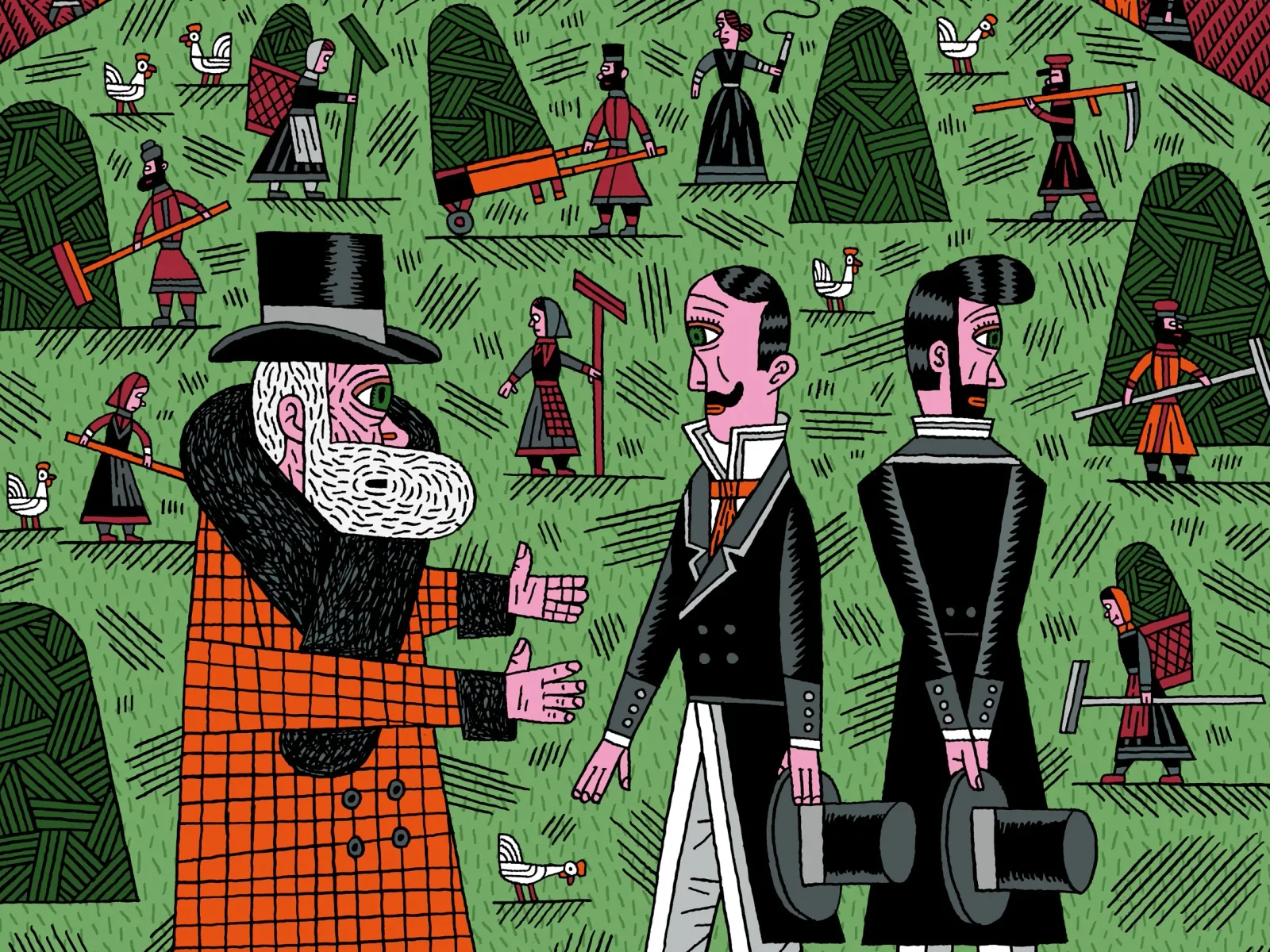
Harlov’s determination was that of an extraordinary man, since at that time, much like today, almost everything revolved around material standing, which leads directly to respect and privileged status on a social plane. Harlov possessed all of this in abundance. Yet, the definitive decision to leave his entire estate—the lands, horses, and property—to his daughters was already finalized. To celebrate and execute the ceremony, many people were invited, including state officials to complete the formalities, friends, and well-wishers. At the feast organized by Martin Petrovich Harlov to delegate his rights, privileges, power, and wealth, people whispered to one another: “He did well,” said one. “They will leave him with nothing,” said another. “He is a great man,” could be heard elsewhere. While all the formalities were being finalized, Harlov felt extraordinary, as though he were accomplishing something no one else would dare do in full health and during their lifetime.
Amidst all the satisfaction that filled him with both joy and sadness, one thing eluded him: the ungrateful, expressionless face of his younger, unmarried daughter, Evlampia. Words were thrown in Harlov’s face across rooms and gatherings: “How can you trust your son-in-law (Sleitkin) enough to leave him the property?”, “Aren’t you worried he will cast you out?” Harlov responded calmly, with the quiet composure of an peerless man: “I am leaving it to my daughters; they will care for me and provide me with food in my study.”
Well thought out and easily said, yet in one's profound and natural trust in children, family, and loved ones, projecting the self-realization of an action from one Ego onto another as a necessity does not always hold relevance, for it may be purely subjective. Our fate is not always secured through the prosperous optic from which we view ourselves and through which our kin view us. Trust only to the extent that this trust yields greater utility than anything material—a trust measured on the scales of pragmatism, ensuring that utility acts as a safeguard for a fate far from the ideal, yet close and relevant to the real.
Father Harlov’s high morality and ideal—which, driven partly by personal fear of death and partly by a cunning imperfection, placed the well-being and elevation of his daughters alongside and above himself—would not merely leave him with a pension to await his death. It was also an emancipatory act through which the capacity of the other (Harlov’s daughters) was measured regarding their responsibility toward others through their newly acquired power.
This blueprint of actions that resided in Harlov’s mind failed to materialize. Through the persistent provocations of Souvenir (Natalia Nikolayevna’s jester/servant), who had witnessed Harlov’s degraded state—a man now left without a word in his tongue or mind—a subtle shift occurred. It was as though Harlov felt something that others were not meant to perceive: a sense of shame before a woodpecker named Souvenir, who tormented him: “So, did they take everything from you?”, “You are left with nothing!”, “You are fit only to be mocked!”, and “They will even leave you without a bed!” These were among the gentlest words hurled with laughter directly at the quiet Harlov, who boiled with shame over the plight into which his own decision had thrust him.
Harlov’s horse was sold, his carriage was taken, and eventually he was evicted from his own study. From a highly respected, deeply honored, and feared landowner, Harlov was instantly transformed into a slave, mocked through the heavy mercy of the daughters whom he, alongside his son-in-law, had adorned with power and wealth.
Not far removed from our own lives and sick ambitions for material things is the lesson that emerges from the doorsteps of thoroughly capitalist societies (from a capital mindset). There are many who strike pacts with ease, trading the irreplaceable, the unrepeatable, and the unrecoverable—which can be lost only once—for a handful of power and a few fingers of wealth.
Human dehumanization certainly does not begin merely with the sick desire to possess, to be recognized for something we are not, or to live in fairytales and dreams that favor only selfish egos. It represents a decaying ontology that has produced—and will continue to produce—beings characterized by such moral traits and qualities, manifesting psycho-social behaviors that are as ambiguous as they are bi- or tri-polar, and deeply disordered in the complete loss of self-image when confronted with the impulse to possess.
Society’s reactions following the expulsion of father Harlov were marked by contempt toward his daughters and son-in-law. In his abyss, Harlov reached the threshold of endurance. As everything was said to him, as he was humbled, despised, and insulted, his tears turned into a great river of repentance—a outcome he could never have imagined.
Driven by ideals and an inability to live under the weight of decisions whose outcomes he had not anticipated as such moral ends (telos), but rather as concrete, satisfying realities benefiting all into a healthy and happy existence (eudaimonia), he took his fate into his own hands. Negatively influenced and fiendishly motivated by the “Souvenirs” of society (the enslaved, cunning, and tyrannical man), cast out by his family, disrespected by his circle, and feeling stripped of dignity before himself, he went to destroy his estate, his land, and everything else, until he suddenly fell from the roof, remaining dead forever.
Harlov’s death must stand as a monument between goodwill and a captive heart; between the spiritual benevolence of a father and a spirit left wounded by its own charity. Ultimately, it serves as a lesson that nothing equals or surpasses the value of a soul with which we give and receive—even if in hostility with it—and from which we gain when we love it, and still gain when we are governed by it.
There is nothing more offensive or degrading to the human spirit than making it an object of mockery in its own benevolence.