LOVE OR FREEDOM?
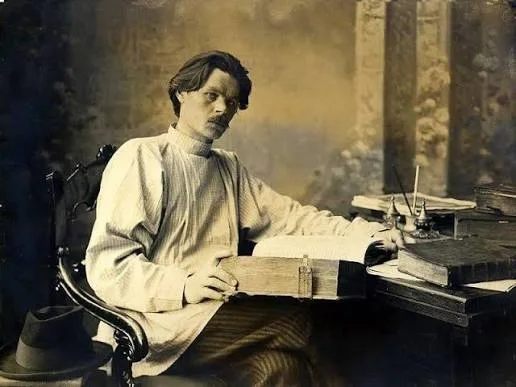
Maxim Gorky’s short story “Makar Chudra,” beyond seeking to present an intriguing and universally recognized dilemma within human society, intends to unveil another sentiment that appears to transcend both love and freedom—Pride. The title of the story is also the name of the protagonist, who serves as the central narrator of Gorky’s meta-narrative. He recounts his tale to the frame-narrator while both stand by the seashore: one (Makar Chudra) tending to several horses and puffing his pipe in an obstructive calm that seems capable of moving rocks, and the other, an unidentified figure who lingers beside him, waiting for a moment of communicative alignment. The old Chudra responds with a fresh brand of nihilism and pessimism to the question, “What are people doing?”—a universal, philosophical query aimed at extracting an objective, universally accepted essence of human and moral reality. Chudra’s profound disinterest in infusing human existence with meaning appears as charming in its articulation as it is anxious, neuralgic, reproachful, and resentful.
Chudra’s discussion with the character by the sea eventually channels toward the treachery of women, their cunning, and their ability—through deep, intense desires for small, seemingly insignificant things—to reveal the strategy of a wartime commander who slays his own army alongside the enemy's, merely to remain the last standing on the horizon of potential crown-bearers. Makar Chudra’s testimony is a narrative drawn from his own lived experience; his senses and mind served as true witnesses to a reality that demands to be kept from oblivion rather than merely believed or remembered, all to preserve the most precious, priceless, and valuable entity—Freedom.
At the epicenter of Chudra’s tale stands a young Romani man named Zobar (Loiko Zobar)—a brave warrior whose name was known to all, and in every village or realm, men waited to ambush and betray him. Yet, none could slay him. His eyes knew no fear of anyone or anything. Chudra spoke of the beauty of his own daughter, Nonka, using her as a benchmark to describe—or at least attempt to describe—the beauty of his friend’s daughter, Radda. “Do you know my Nonka? She is beautiful as a queen! But before Radda, she is nothing. Radda’s beauty cannot be told in words. Her beauty can only be sung on a violin, and even then, only by one who knows the violin as he knows his own soul”—these are Chudra’s words regarding the daughter of his friend, Danilo. The great warrior, having heard that Radda had wounded many brave hearts and saddened the souls of many long-mustachioed men, rode his horse while his jewel-encrusted sword flashed at his side. Looking Radda in the eyes, he said: “Come here! Kiss me once, and I will give you a bag of gold.” Radda turned her back in deep disregard and lethal contempt; she did not deign to look at him twice, let alone condescend to respond to the great, tall hero who gleamed with pride and nobility.
Loiko Zobar had evidently fallen into the trap of love; the bravest of the brave had forgotten the battlefield and the comforting whirl of his sword. The next day, our hero set off toward Radda’s father: “Sell me your daughter; ask whatever price you wish!” uttered Loiko Zobar in disgust, burdened and crying out like a wounded man unaccustomed to being denied what he desires. “Only the pans sell everything—their pigs and their souls alike; but I fought under Kossuth, and I sell nothing,” replied the fearless, noble Danilo, holding his chest high with a proud heart. Our aggrieved hero, feeling diminished in his soul, drew his sword from its scabbard, making himself smaller still than he had already become. One of his own whispered words of madness, pettiness, and shame into his stallion’s ear to ignite the horse, which moments later galloped away. Nothing is greater than the capacity of a soul to remain calm precisely at the moment it desires to destroy everything, motivated by a wound born of rejection and denial, feeling unaccepted and unloved. Greatness must sometimes lie in understanding the insignificance of the soul's importance to others, so that eventually everyone realizes how magnificent it is to be conscious of the futility of being great.
A true hero is only one who has persuaded his fate to follow a single path—one toward the unyielding, so as to remain unyielding himself. Two or three days later, Loiko Zobar returned like a little child whose desires had gone unfulfilled, who had fled in great anger to his sand pit to nurse a grudge that only served to magnify the pettiness of his soul. Yet, this pettiness was not truly humiliation or contempt. How can a man who loves be small, weak, or degraded? How can the most beautiful human emotion bring to their knees great heroes whose songs will be sung for centuries and millennia? “I swear by God that I speak with a pure heart! Give me this girl as my wife! I am very rich, and I will share all my wealth with you!” cried Loiko Zobar, swaying in his saddle like steppe grass in the wind. “Speak, my daughter,” Danilo asked his daughter Radda. “What would happen if an eagle entered a raven’s nest of its own free will?” Radda asked all present. Danilo raised his head high; his pride had taken wing. Radda filled her father’s heart with the power of a king who would not have traded her for the greatest warriors in military history. “Well spoken, my daughter! Did you hear, noble sir? It cannot be! Look for a dove; they are gentler,” Danilo replied to our hero. Loiko Zobar nearly lost his mind; he snatched off his cap, hurled it to the ground, and rode off so wildly that the earth trembled.
As Makar Chudra recounted this story to the character who in turn narrates it all to us, he marvelled and mused: “Look at what a girl Radda was,” the old Chudra said with admiration.
Music: The Royal Road to Closed Hearts
Makar Chudra continued his tale, describing a particular night where they sat gathered together. Suddenly, like a star piercing through the dark into light, they heard a song floating across the steppe. “It was a beautiful song! It made the blood boil in your veins to hear it!” Makar Chudra recalled. From the darkness emerged a horse and rider resembling a figure from a fairytale, playing the violin. He approached their fire and looked upon them all with a smile. “It is you, Zobar!” exclaimed Danilo joyfully. Indeed, it was our hero, Loiko Zobar, who had exchanged his lethal, head-severing sword for the violin—a “sword” that extracted hearts instead.
The true warrior does not know failure or despair; he knows neither surrender nor oblivion. The warrior is the true heart and enduring witness of human purpose and essence. A warrior’s bravery does not lie in his sword, nor in his lack of fear when facing death. A warrior’s genuine courage is his inability to surrender to madness, shame, and the fear of being inadequate, small, unaccepted, worthless, or unloved. This is what renders the warrior immortal.
Radda approached Loiko Zobar as if she had no other choice: “You play the violin well, Loiko! Who made this violin that plays so beautifully and sweetly?” Loiko’s face filled with a restrained joy; he smiled softly and said: “I made it with my own hands! It is not made of wood, but from the chest of a girl I loved deeply! The strings were drawn from her heart.” Loiko Zobar had done everything to captivate her mind and ignite her heart so that she might love him. It seemed the battle was won, love was ignited, and freedom was secured. Yet how often have kings lost their heads to arrogance after winning battles, undone by their inability to master their hearts before glory and greed? How often has the mind fled its vessel, believing everything was settled, only to leave everything unfinished?
Radda turned her head and yawned, appearing bored and annoyed: “I had heard Zobar was a clever and skillful man, but now I see the world lies!” So spoke the sharp-tongued Radda, walking away and leaving our hero stripped of the good feelings that had touched his heart, soul, and mind for only a fleeting moment.
On another occasion, they gathered to discuss various matters. Danilo asked Loiko to sing a song and gladden their spirits. Radda lay a short distance away, showing no interest—or at least appearing not to. That night, the violin sang with its most beautiful voice. Loiko began his song, and his voice joined the dance:
“Hop, hop, like an arrow flies My horse across the steppe! A fire burns within my chest— And the steppe knows no end.”
He captured Radda’s attention; she turned her head and looked the singer straight in the eyes. Flaming and consumed, he continued:
“Mist covers the entire steppe, Vast as the ocean sea. There, my friend, in wide expanses Our dawn awaits us. My horse gallops like an avalanche, Flying through the clouds, And its purple mane almost touches The sleeping white moon.”
Radda spoke mockingly as they listened to the sweet-voiced singer spreading joy throughout the gathering: “Do not fly so high, Loiko, or you will fall nose-first into the bog and bend your mustache.” Everyone had enjoyed the hero's song; Danilo was thoroughly melted by the notes that cradled his thoughts and softened his harsh temper. Everyone loved the song, except Radda.
The game did not stop. Both attacked and defended simultaneously. Everything had taken the course of a “bloody” battle for love and pride. Loiko walked slowly, head bowed, hands hanging like willow twigs. A short distance away lay old Makar Chudra, recounting the event. Radda emerged from her tent and approached him hurriedly. Coming up from behind, she placed her hand on his shoulder; Loiko whirled around, knife in hand, ready to strike—ever the vigilant warrior who slays shadows. Radda cried: “Drop the knife! If you don't, I'll fill your head with lead!” She had trained her pistol straight at Zobar’s forehead. She placed the pistol in her belt and turned to him: “I did not come to kill you, but to make peace.”
Radda spoke to Loiko with the sweetest words a desired maiden could utter. In the end, she told him: “I love you!”
The only thing Radda left as more desirable than all else to Loiko, after this entire Odyssey, was freedom. “I have never loved anyone in my life, Loiko, but I love you. Yet besides you, I love freedom! Loiko, I love freedom more than you!”—she told him, leaving him shaken in the depths of an unease that even the sweetest words could not soothe. Beautiful as her words sounded, within that orbit of beauty appeared the grim visage of an abyss swallowing his soul. Radda’s love came with a single condition to complete this fairytale: she demanded that tomorrow, our hero bow on both knees and kiss her hand, begging for her heart before all the renowned men of the camp. Zobar was shattered by this request from the devil named Radda. It was contrary to their tradition to bow to women for a share of their heart and peace of soul. Loiko had to strike a special bargain with the devil: surrender pride to gain love!
The next day, before all the assembled men, Radda waited for the bravest of the brave to bow. Loiko Zobar, whose sword had sent hundreds of souls to the underworld, was forced to kneel before Radda, stripped of all warrior virtue and fame before men who spoke of him with reverence and honored him as an irreplaceable hero.
In the midst of them all, Radda called Zobar to perform the “rite” upon which they had agreed. No one knew what Zobar intended. He approached Radda, and suddenly everyone saw her roll to the ground. Zobar had plunged his knife into her chest up to the hilt. Radda spoke her final words of farewell: “Farewell, Loiko! I knew you would do this...!” And she died.
At that very moment, where Radda closed her eyes among the men before whom she had demanded the hero’s submission, her father Danilo awoke to action and drove his knife from behind, straight into Loiko’s heart. “Well done,” Loiko said to Danilo, turning to collapse beside the dead Radda.
Freedom required love to fulfill itself as a singular whole and totality; while love required freedom to expand and rise as a testament to eternity through the bowing of invincible, powerful souls. Love or freedom? Neither, and yet both together—as something beyond, which cannot be crowned into life by the guardian whose eyes gleam and whose mustache does not tremble—Pride.